How Many Systems Does It Take to Run an Aesthetic Clinic?



 Jul 14, 2026
 7 min read
Running an aesthetic clinic involves far more than delivering treatments.
From first booking to ongoing aftercare, the work of running a clinic spans multiple stages. The problem is not the number of tasks. It is when every task sits in a different system.
Bookings may be managed in one platform. Consent forms may be stored elsewhere. Patient records may require a separate login. Aftercare instructions may be sent manually. Payments, reminders and team calendars can add even more tools to the mix.
Each individual system may work perfectly well. The difficulty begins when they do not work together.
The hidden cost of fragmented clinic admin
Switching between multiple platforms can quickly become part of the working day without anyone questioning how much time it consumes.
A professional may move from the booking calendar to an email inbox, then to a patient-record system, followed by a payment tool and another platform for consent forms.
That creates more than inconvenience.
It can lead to repeated data entry, duplicated information and extra steps whenever an appointment changes. Staff may need to search across different systems to understand where a patient is within their treatment journey.
The real cost is not simply the number of subscriptions a clinic pays for. It is the time and attention spent moving between them.
For solo professionals, that can mean extra administration at the end of an already busy clinical day.
For larger clinics, fragmented systems can make it harder to maintain consistent processes across professionals, teams and locations.
When clinic systems are disconnected, the patient journey can be too
Back-office organisation may not be visible to patients, but its effects often are.
Patients expect booking information to be clear. They want appointment confirmations to arrive on time, forms to be easy to complete and aftercare guidance to be readily available.
When information is spread across several platforms, the clinic team may need to connect each stage manually.
A booking change may need to be updated in more than one place. Consent information may not sit alongside the rest of the patient record. Aftercare may depend on someone remembering to send it separately.
A more connected system can support a more consistent experience from first booking through to follow-up care.
That does not remove the clinic's responsibilities. Medical professionals and clinics remain responsible for accurate records, appropriate consent, secure handling of patient information, clinical decisions and suitable aftercare.
Technology should support those responsibilities, not replace them.
What should an all-in-one clinic platform include?
An all-in-one platform should do more than place several unrelated tools behind one login.
The value comes from connecting the different stages of the clinic and patient journey.
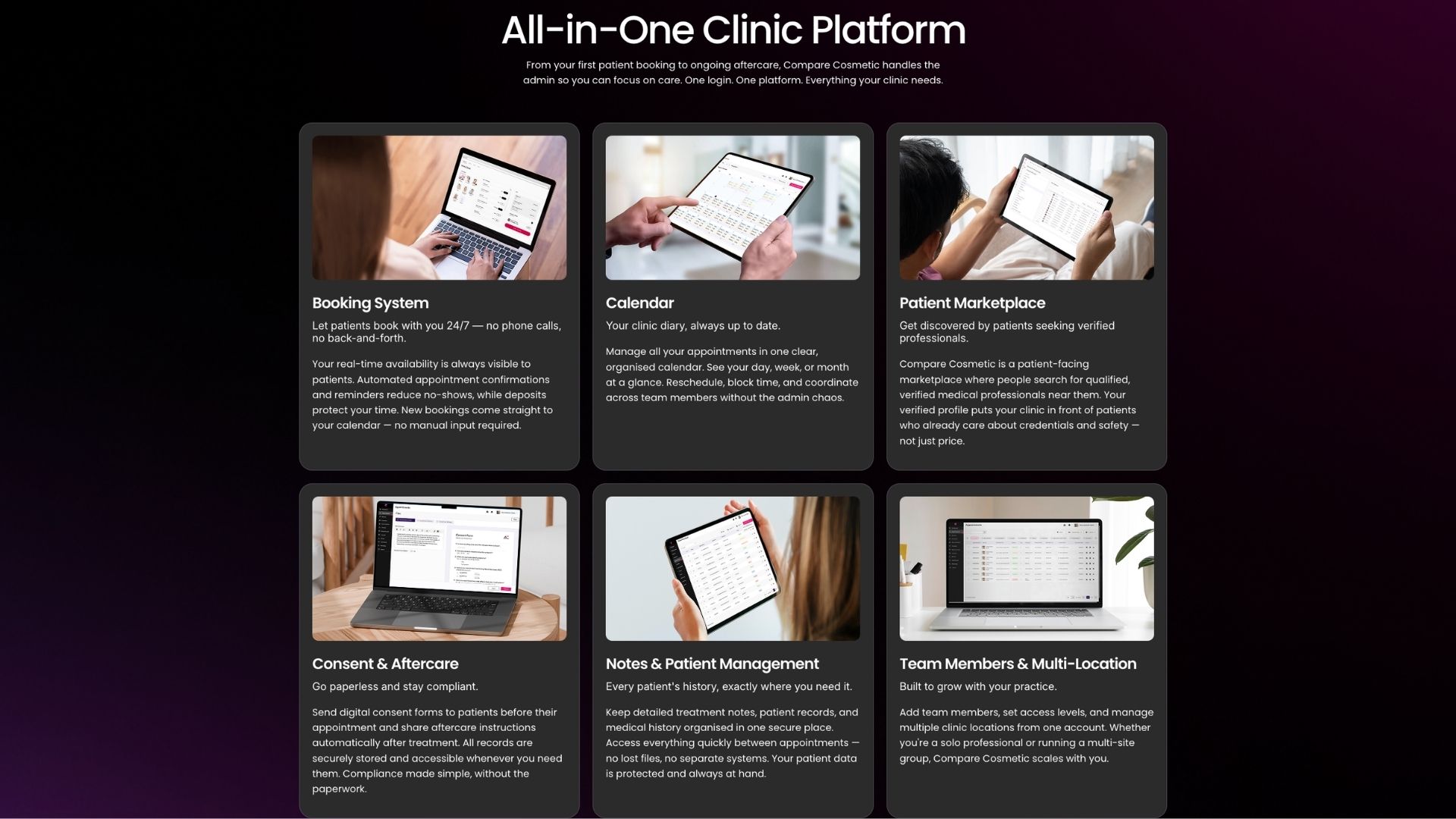
Online booking and real-time availability
Patients increasingly expect to view availability and book without relying on telephone calls or lengthy message exchanges.
A connected booking system should place new appointments directly into the clinic calendar, helping reduce manual entry and the risk of scheduling errors.
Automated confirmations and reminders can also support smoother communication and reduce avoidable back-and-forth.
A clear clinic calendar
The calendar is often at the centre of clinic operations.
Professionals need to see upcoming appointments, reschedule patients, block out time and coordinate availability across team members.
For clinics operating from more than one location, the ability to manage several diaries within one system becomes even more important.
Digital consent and aftercare
Consent and aftercare should not feel detached from the appointment itself.
Digital consent forms can be sent before treatment, allowing patients time to read and complete the relevant information.
Aftercare instructions can then be shared after the appointment, helping patients understand what to expect and when to contact the clinic if they have a concern.
These processes still require appropriate professional oversight, but a connected platform can make them easier to manage consistently.
Patient records and treatment notes
Patient information should be available where the clinic team needs it.
Keeping treatment notes, medical history and appointment information together can reduce the need to search through separate systems or files between appointments.
Access must still be carefully controlled, and clinics remain responsible for complying with applicable data protection and professional requirements.
Payments and patient communication
Payments, deposits and appointment communication are also part of the clinic journey.
When these functions are disconnected from the booking and calendar system, clinics may need to reconcile information manually.
Bringing them together can create a clearer view of each appointment and reduce repetitive administration.
Team and multi-location management
The systems used by a solo practitioner may no longer be sufficient once a clinic begins to grow.
A scalable platform should allow clinics to add team members, control levels of access and manage multiple locations from one account.
Compare Cosmetic's medical professional platform includes booking, calendar management, consent and aftercare, patient records, payments, team access and multi-location management. It is designed to support solo professionals as well as growing and multi-site clinics.
Clinic management and patient discovery in one place
Many clinic-management systems focus only on what happens after a patient has already found the clinic.
Compare Cosmetic also includes a patient-facing marketplace.
Qualified medical professionals can create verified profiles that allow patients to find them, view relevant information and book through the platform.
This means the same system can support both sides of the clinic journey:
-
helping new patients discover the clinic
-
allowing them to book
-
placing the appointment into the clinic calendar
-
supporting the surrounding administration and patient communication
For clinics, that creates an important distinction.
The platform is not only helping manage existing demand. It also provides a route through which qualified professionals can become more visible to patients who are actively looking for aesthetic care.
Why trust should sit alongside booking
In aesthetics, visibility alone is not enough.
A professional may have strong social media content, positive reviews and an attractive clinic. Patients still need clear information about who is carrying out the treatment and what credentials they hold.
Compare Cosmetic checks professional registration, insurance, training and identity before a verified professional goes live. Professional standing and registration are then monitored on an ongoing basis.
Placing this information within the same journey in which patients search and book helps make credentials more visible at the point of decision.
Verification does not guarantee a treatment outcome, replace a consultation or determine whether a procedure is suitable for an individual patient.
Compare Cosmetic is a neutral third-party platform. It does not provide medical advice, assess clinical suitability or control the clinical decisions of independent providers. Treatment decisions remain between the patient and the chosen professional.
What should clinics look for when choosing a platform?
Before moving to a new system, medical professionals should consider whether it supports the way their clinic actually works.
Useful questions include:
-
Can patients view availability and book online?
-
Do appointments flow directly into the clinic calendar?
-
Can the system manage different professionals' and locations?
-
Are consent forms and aftercare connected to the patient journey?
-
Can treatment notes and relevant patient information be accessed securely?
-
Are payments, deposits and communications integrated?
-
Does the platform support the clinic as it grows?
-
Can it help suitable patients discover the clinic?
-
Are verification standards clear?
-
Is pricing transparent, and what support is available?
One connected clinic journey
An all-in-one platform should reduce unnecessary complexity. It should not simply introduce another system for the clinic team to manage.
Running an aesthetic clinic should not mean piecing together every stage of the patient journey across disconnected tools.
A more connected platform can reduce repeated administration, support clearer internal processes and help create a more consistent experience for patients.
Compare Cosmetic brings clinic management, patient discovery and professional verification together in one place.
Professionals can manage bookings, calendars, consent, aftercare, patient information, payments, teams and locations while also building visibility through a marketplace designed around qualified and verified aesthetic practice.
One login. One platform.
Less admin. More time for care.
Ready to bring your clinic management together? Explore what we can offer and sign up options with us.
Looking for an aesthetic professional? Search, compare and book through Compare Cosmetic.